How can European policies better reflect the connections between rural and urban areas? And how can local experiences, research findings and emerging innovations be translated into practical policy recommendations?
These questions were at the centre of the first RURBANIVE Policy Recommendation Workshop, held online on 26 May 2026. Organised by the European Association for Innovation in Local Development (AEIDL) within the RURBANIVE Forum, the workshop marked the beginning of a structured and iterative process that will contribute to the project’s final policy report, expected in December 2027.
The session brought together experts, policymakers, researchers and practitioners to identify and refine the main challenges affecting rural–urban linkages across Europe. Contributions from the project’s Rural–Urban Co-Creation Labs helped connect the policy discussion with concrete territorial experiences.
Building a shared understanding of rural–urban challenges
Opening the meeting, Serafin Pazos Vidal from AEIDL introduced the RURBANIVE Forum as a series of online and hybrid policy dialogue sessions designed to translate the project’s research and experimentation into policy-relevant insights.
Rather than treating rural and urban areas as separate spaces, the Forum looks at the flows, dependencies and relationships connecting them. This first workshop represented an important transition from broad exploratory work towards a more focused and policy-oriented understanding of the challenges that need to be addressed.
Kostas Naskou from Institute of Communication and Computer Systems (ICCS), RURBANIVE Project Coordinator, then presented the project’s overall objectives and approach.
RURBANIVE brings together 17 partners from eight countries and aims to engage approximately 700 stakeholders during its 48-month implementation period. Through a combination of social and technological innovation, the project seeks to improve rural communities’ access to services and opportunities, strengthen cooperation between territories and reduce rural–urban disparities.
Its work is implemented through Rural–Urban Co-Creation Labs in seven European countries, where local and regional actors jointly design and test solutions adapted to their territorial needs. These activities are supported by a wider community of practice, a community store for sharing tools and knowledge, and extended reality technologies that can make territorial challenges and interactions more accessible and tangible.
The project’s experimentation and policy work are organised around six Rural–Urban Enablers:
- Improving logistics and shortening value chains
- Ecosystem and biodiversity restoration
- Circular bioeconomy
- User engagement, empowerment and territorial awareness
- Culture, landscape and heritage access and promotion
- Enhanced mobility
Looking beyond administrative boundaries
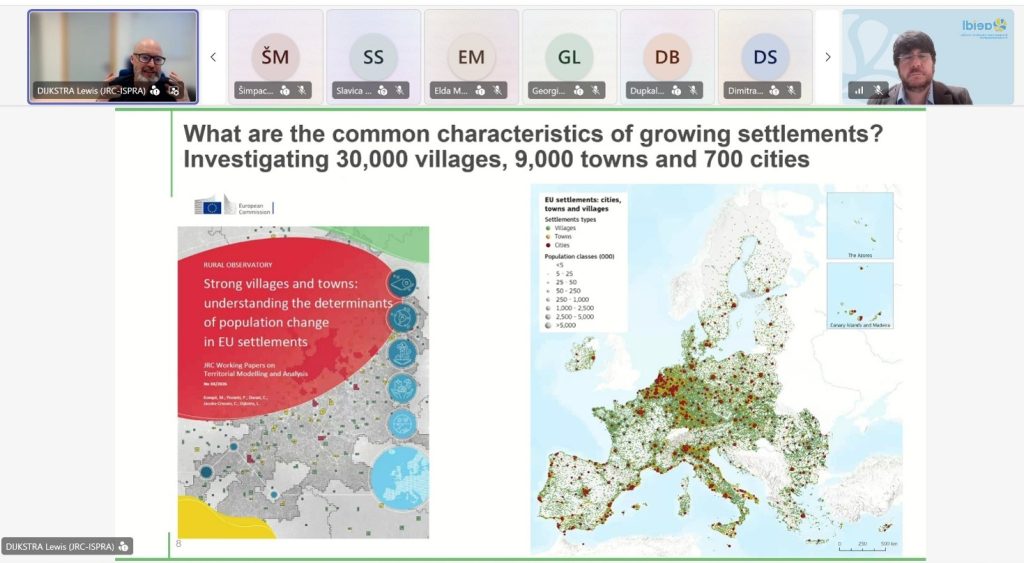
A keynote contribution from Lewis Dijkstra, Urban and Territorial Policy Lead at the European Commission’s Joint Research Centre, introduced the concept of functional areas and its relevance to territorial policymaking.
Administrative borders do not always reflect how territories operate in practice. Employment, commuting, access to services, economic activities and social interactions often connect several municipalities or regions. Functional areas therefore offer a way to understand territories through the relationships and activities that link them rather than through administrative boundaries alone.
This perspective is particularly relevant to rural–urban cooperation. It reveals the flows of people, goods, services, knowledge and investment between urban centres and surrounding rural territories, while helping policymakers understand their mutual dependencies.
Functional approaches can consequently support more integrated responses to demographic change, labour-market pressures, access to public services, mobility challenges and the green transition.
However, Dijkstra also stressed that defining functional areas is not simply a technical task. Methodological choices can influence how territorial inequalities are measured, how challenges are understood and where policy support is directed. Consistent, robust and comparable methods are therefore essential for effective evidence-based policymaking.
From local food processing to stronger value chains
Following the keynote, participants worked in two parallel groups, examining the six thematic domains through practical examples from RURBANIVE’s Co-Creation Labs and partner activities.
The discussion on logistics and shorter value chains drew on the work of the Czech University of Life Sciences Prague.
Its 570-hectare campus in Prague–Suchdol hosts a Food Processing Training Centre with six facilities dedicated to meat, dairy, fruit and vegetable processing, bakery production, brewing and oil pressing. The centre combines practical education with the processing and sale of locally produced food.
Through hands-on workshops and a digital learning platform, the initiative supports farmers, food producers, students, researchers and other regional stakeholders in developing knowledge about food transformation, certification and short supply chains.
It also aims to encourage local agri-food entrepreneurship by helping participants develop business activities based on regional raw materials. However, the discussion highlighted the continuing need to strengthen the position of small farmers within value chains and provide the skills, infrastructure and coordination required for local food businesses to grow.
Creating more connected innovation ecosystems
Agrifood Lithuania presented work taking place in the Kėdainiai region, where the objective is to build a more connected rural–urban innovation ecosystem.
The initiative brings together municipalities, SMEs, NGOs, Local Action Groups, tourism and business support organisations, educational institutions, employment services, regional development actors and other innovation stakeholders.
Activities have included stakeholder mapping, analysis of the regional innovation ecosystem, co-creation workshops, capacity-building on rural innovation and demonstrations of immersive rural–urban approaches. Feedback collected from participating stakeholders is being used to guide the initiative’s next steps.
Despite the presence of numerous organisations and initiatives, support structures remain fragmented. Institutions frequently work in parallel rather than as part of an interconnected system, while rural and urban development strategies are not always sufficiently aligned.
Gaps in early-stage entrepreneurship and innovation skills were also identified. Addressing these challenges will require stronger coordination across institutions and more integrated support for rural innovation.
Using data to improve rural–urban mobility
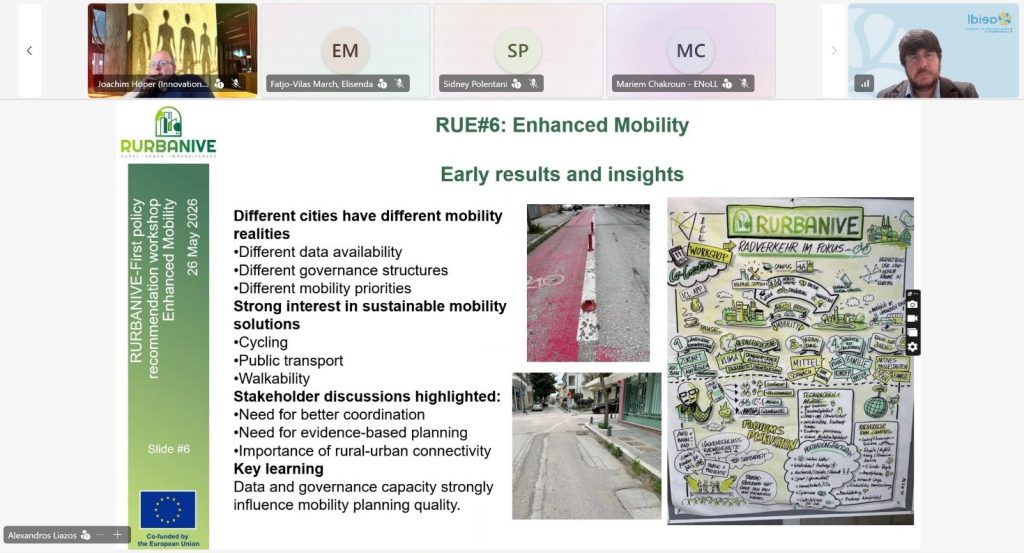
The mobility discussion focused on work led by ICCS in collaboration with e-Trikala in Greece and Innovation Campus Lemgo in Germany.
The initiative explores how mobility data, simulations and local participation can support more sustainable and accessible connections between rural and urban areas.
Municipalities, transport authorities, mobility operators, researchers, businesses, citizens, commuters and cyclists are involved in the process. Activities include collecting and analysing mobility data, developing simulation scenarios, organising stakeholder workshops in Trikala and Lemgo, and integrating local mobility needs into planning and policy discussions.
The work covers public transport, cycling, walking, behavioural change and wider sustainable mobility planning.
Several barriers remain, including fragmented governance, limited coordination between different administrative levels and uneven availability of harmonised mobility data. Limited long-term funding can also make it difficult to continue promising pilot initiatives, while policy uptake of innovative mobility solutions is often slow.
Participants therefore underlined the need to connect mobility planning more closely with wider regional development strategies.
Restoring ecosystems in complex territorial settings
In the second working group, IMERYS and the Agricultural University of Athens (AUA) presented their work on ecosystem and biodiversity restoration on Milos Island.
Milos combines a long history of mining with distinctive geological formations, protected natural areas, agricultural activities and a tourism sector closely linked to its landscape.
The initiative seeks to restore soils affected by quarrying activities while creating a more coherent relationship between natural, agricultural and tourism-related land uses. It brings together public authorities, municipal representatives, agri-food producers, tourism professionals, foresters, agronomists, educators and entrepreneurs.
Nature-based solutions are combined with microbiome-based methods, UAVs, IoT sensors and precision-monitoring tools. The objective is to support the reintroduction of native vegetation, monitor restoration outcomes and explore opportunities for drought-resistant agricultural production that can create local social and economic benefits.
The example also revealed important policy gaps. These include limited site-specific guidance for post-mining restoration under EU biodiversity objectives, complex coordination between environmental and mining authorities, tensions between Natura 2000 protection and active extraction sites, and insufficient funding mechanisms for restoration within operating mining areas.
Turning biomass and organic waste into regional resources
Alchemia-Nova research and innovation and BioBASE led the discussion on circular bioeconomy, examining how rural and urban biomass flows can be reorganised to create new regional value chains.
Organic waste and residual biomass from farms, food processors, retailers, catering businesses and urban areas can potentially be transformed into resources for new products and applications. Better mapping of these streams, improved nutrient exchange and new circular business models could reduce waste while generating employment and economic opportunities.
Achieving this transition requires cooperation between farms, food companies, waste-management providers, logistics actors, municipalities, startups and universities. Digital training and interdisciplinary collaboration were also identified as important enabling factors.
However, circular solutions continue to face significant legal and economic barriers. Waste-classification rules may restrict the reuse of certain materials, while information about biomass streams can be limited, fragmented or commercially sensitive.
Responsibilities are often spread across several authorities without a clear coordination structure. At the same time, established linear systems can remain less expensive than circular alternatives, making it harder for new models to compete.
Understanding how people value cultural landscapes
The culture, landscape and heritage discussion featured work by CARTIF in the Valles Pasiegos area.
The initiative uses cognitive computing techniques to explore how people perceive and emotionally respond to rural cultural landscapes. The intention is to translate these responses into indicators of “affective value,” providing a deeper understanding of both the tangible and emotional qualities associated with a place.
These insights could support more targeted communication and territorial development strategies aimed at attracting visitors and potential residents.
The regional government plays a coordinating role, bringing together cultural and heritage stakeholders and working with CARTIF to define requirements and refine the tools through a co-creation process. Rural and urban participants are also being selected for ethically compliant testing of emotional responses to the Valles Pasiegos landscape.
One cognitive computing tool has already been completed, while data are being collected for a second. A mock-up has been prepared for the integration of a third tool, and a neural network model has been trained for a fourth.
Nevertheless, the work is affected by wider challenges, including fragmented policies, undervaluation of cultural assets, the absence of shared measurement frameworks, limited funding and insufficient integration of culture and landscape into broader territorial strategies.
Fragmentation as a common challenge
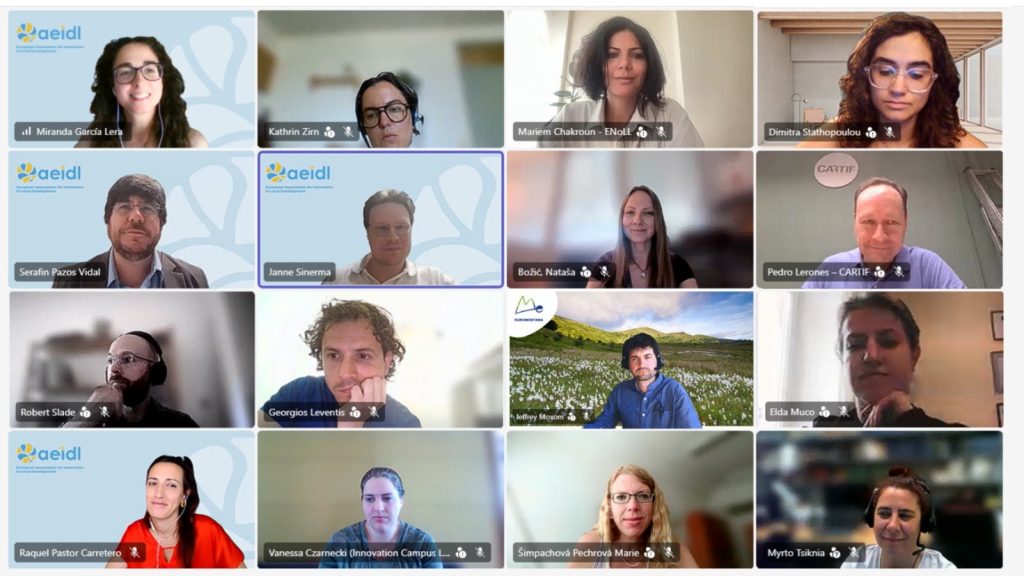
During the plenary session, moderated by Janne Sinerma from AEIDL, rapporteurs brought together the main messages from both working groups.
Reporting from the first group, Mariem Chakroun from ENoLL highlighted the importance of developing integrated rural–urban ecosystems for sustainable regional development.
Across logistics, innovation and mobility, a common issue was not necessarily the absence of initiatives, but the weak coordination between existing actors, organisations and support structures. Rural and urban territories need to be approached as interconnected systems requiring long-term planning and cooperation between public authorities, businesses, farmers, researchers, transport operators and local communities.
The discussion also highlighted the importance of supporting small farmers and understanding innovation as an ecosystem process, combining experimentation, reliable data, local knowledge and place-based policy design.
Reporting from the second group, Nataša Božić from the University of Ljubljana identified similar cross-cutting issues related to complex governance, funding limitations, policy barriers and stakeholder coordination.
The examples demonstrated the potential of practical restoration methods, circular approaches that transform waste into resources, and emerging AI- and data-driven techniques for assessing cultural landscapes. At the same time, they showed that experimentation must be accompanied by stronger data foundations, improved governance and more supportive policy frameworks.
The first step in an iterative policy process
Closing the meeting, Serafin Pazos Vidal emphasised that the workshop was not a standalone event. It was the first stage of an ongoing co-creation process through which the identified challenges will be further examined, refined and connected with potential policy responses.
The results will inform the next RURBANIVE Forum sessions and progressively contribute to a coherent and actionable set of recommendations.
Rural–urban linkages are becoming increasingly visible across the current EU policy agenda, including cohesion, mobility, biodiversity and innovation policy. By bringing local experimentation, research evidence and policy expertise into the same conversation, RURBANIVE aims to help ensure that these connections are more effectively reflected in future territorial policies.
The next RURBANIVE policy workshop is scheduled for December 2026, continuing the journey from shared challenges towards practical policy recommendations for stronger and more balanced rural–urban cooperation across Europe.